
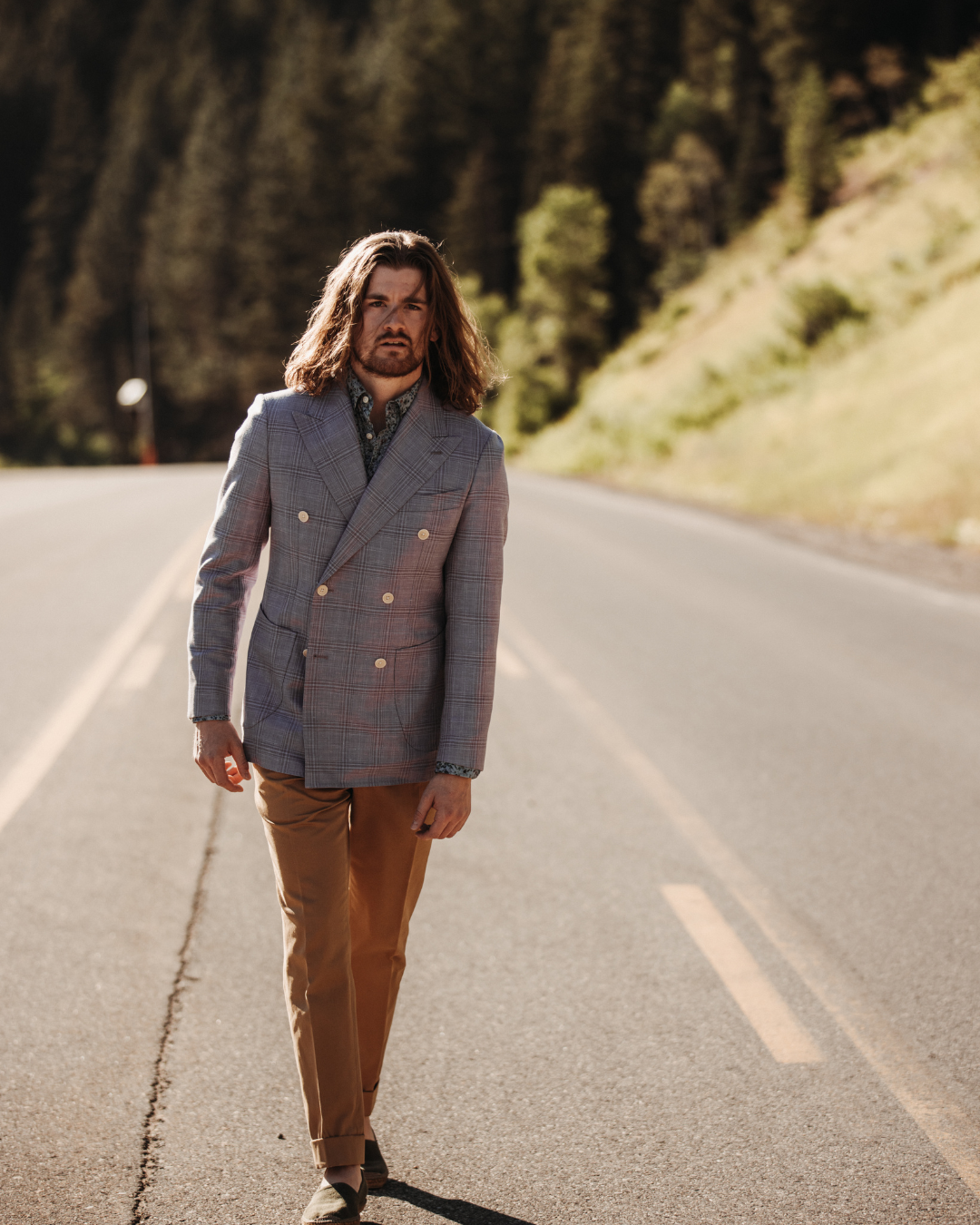
What Mountain Luxury Actually Means
The phrase "mountain luxury" gets tossed around loosely, but in Northern Utah it describes something specific. It's the point where high-altitude living meets genuine craftsmanship, where the rugged geography of the Wasatch Range shapes how men actually dress, rather than simply borrowing a coastal or European wardrobe and hoping it translates.
This isn't a compromise on quality. It's a different set of priorities. Luxury fashion for men in this context emphasizes tactile depth, structural ease, and versatility across dramatically different settings—a Board meeting in downtown Salt Lake, an evening dinner at a Park City resort, an afternoon on Main Street during Sundance; the wardrobe that works here is one built for transitions, not a single occasion.
Quiet confidence is the defining characteristic. Instead of logos or aggressive pattern work, the focus falls on construction quality and material character—the weight of a cashmere weave, the natural drape of an unlined jacket, the way a well-chosen color coordinates with the surrounding alpine landscape. The point is, especially in Northern Utah, the material of your clothing is part structural requirement for handling the shifting environment and part stylistic choice, rather than just one or the other.
Fabric First: Dressing for the Wasatch Climate
Our climate is genuinely unusual from a dressing perspective. Low humidity, intense alpine sunlight, and temperature swings of 30 degrees or more between midday and evening create conditions that expose the limitations of mass-produced formalwear quickly. Synthetic blends trap heat. Flat commercial wools offer no thermoregulation, and tightly fused interlinings crack and bubble with repeated temperature cycling.
The fabrics that perform well here are the same ones that define premium men's suiting at the top of the market: open-weave fresco wools, bamboo-and-silk blends, and fine worsted cashmeres. These materials breathe, adapt, and—critically—they don't look like they're working hard. A fresco wool jacket at a high-altitude outdoor event reads the same as one in a climate-controlled ballroom. That versatility is exactly what men’s luxury fashion in this region demands.
Textiles Worth Seeking Out
· Fresco wool: The open weave construction breathes in heat and provides structure in cool air.
· Wool-silk blend: This blend is lightweight and fluid; ideal for summer and high-altitude daytime events.
· Fine worsted cashmere: Fine worsted cashmere provides exceptional warmth without bulk; the perfect material for fall and winter.
· Bamboo-silk: Naturally thermoregulating, this material is becoming increasingly common in premium men's suiting collections.
· Tweed and flannel: Classic tweed and flannel are richly textured and well-suited to mountain resort environments in cooler months.
The Unstructured Sport Coat: The Cornerstone of Mountain Dressing
If there's one item that defines luxury fashion for men in a mountain resort market, it's the unstructured sport coat. Traditional tailoring leans on internal shoulder pads, heavy canvas breast pieces, and stiff sleeve heads to create a structured silhouette. That construction makes sense in a formal corporate context. In Park City or Deer Valley, it tends to read as overdressed and rigid.
The unstructured jacket removes those internal components entirely. What remains is a garment shaped by the cut and the fabric alone—soft on the shoulder, natural in its drape, comfortable in the way a great sweater is comfortable, but polished in the way a tailored jacket is polished. It's a narrow target to hit, and when the fabric and construction are right, the result is immediately apparent.
In a high-texture wool-silk-linen blend or a refined seasonal tweed, an unstructured sport coat pairs naturally with tailored trousers, refined denim, or fine knitwear. It's a versatile anchor piece—and for any man building a wardrobe suited to the Northern Utah lifestyle, it's the right place to start.
Layering with Intention: Premium Men's Suiting Beyond the Office
Layering is a practical necessity in high-altitude environments, but in luxury menswear it's also one of the most effective tools for creating visual depth and adaptability. The key distinction is intentionality—each layer chosen must contribute something specific to the overall composition, not just be added for warmth.
A well-considered layering sequence might begin with a fine-gauge merino turtleneck or long-staple cotton knit as the base. A lightweight tailored waistcoat or soft suede vest adds core warmth and visual interest at the mid-layer. The outer layer—a sport coat or soft-shouldered piece from a premium men's suiting collection—ties the composition together.
The practical benefit of this approach: as temperatures shift through the day, removing the jacket doesn't undo the outfit. Each layer is complete on its own. That level of thought is what separates a genuinely functional luxury wardrobe from one that only works in controlled conditions.
Why High End Fashion Suits Work Better in Casual Settings Than You'd Expect
There's a persistent misconception that high end fashion suits belong exclusively in formal settings—weddings, black-tie events, corporate presentations. In practice, the opposite is often true. The superior construction of a genuine luxury suit makes it more adaptable to informal settings, not less.
The reason comes down to how your garment moves. Lower-tier suits use chemical fusing and rigid interlinings that create a stiff silhouette, one that can look awkward and out of place anywhere outside a formal office. High end fashion suits built with floating horsehair canvas and hand-stitched armholes move differently. They have a fluidity that reads as effortless rather than dressy, which is exactly the register needed at an upscale gallery opening or a dinner at a mountain estate.
The styling does some of that work, too. Pair a tailored suit with a refined knit polo instead of a structured dress shirt, swap the leather Oxford for a clean suede Chelsea boot, and the formal associations dissolve. What remains is an outfit that projects considered sophistication without announcing effort.
What to Look for in a Men's Luxury Fashion Store
Not every retailer that uses the word "luxury" operates at that level. The difference between a genuinely premium men's luxury fashion store and a high-margin standard retailer usually becomes clear in the first few minutes of conversation—specifically in whether the clothier can discuss construction, fabric origin, and regional fit considerations rather than simply pointing to the current season's offerings.
A men's luxury fashion store operating at the right level for the Northern Utah market should carry unstructured outerwear, technical cashmere pieces, and premium men's suiting designed for the alpine lifestyle—not just formal office dressing. Access to fabric books from heritage mills like Loro Piana, Piacenza 1733, or Vitale Barberis Canonico is one strong signal. Another is the clothier's ability to walk through color theory, texture pairing, and how different canvas weights behave across the region's seasonal range.
The relationship matters as much as the inventory. A trusted clothier becomes a genuine design partner—someone who understands the wardrobe requirements of a man who moves between professional settings, social events, and outdoor environments week to week.
Dressing for Park City's Social Calendar
The social landscape of Park City demands a particular kind of versatility. Sundance Film Festival events, gallery walks along historic Main Street, dinner reservations at Deer Valley—these settings blend international sophistication with a relaxed mountain sensibility that's unique to the region. The wardrobe that works here threads that needle without visible effort.
For an evening cultural event, a dark charcoal or deep olive unstructured suit in a high-texture wool-and-silk blend reads as polished without feeling stiff. A fine-gauge knit sweater in place of a dress shirt softens the look while keeping it composed. A clean leather trainer or refined suede Chelsea boot completes the picture—formal enough for the setting, relaxed enough for the environment.
This is where high end fashion suits demonstrate their real value: not in a formal receiving line, but in the nuanced social situations that don't fit neatly into "formal" or "casual." The right garment, worn with the right intention, handles both.
Men's Tailoring in Park City: Where Fit Becomes the Point
The finest fabric in the world underperforms in a garment that doesn't fit. That's not a cliché, it's the fundamental argument for investing in proper men's tailoring. A master tailor doesn't work from size tags. The body is treated as an individual structure: its specific posture, shoulder slope, chest-to-waist ratio, and proportions all factor into how a pattern is adjusted before a single seam is cut.
Men's tailoring in Park City and across the Northern Utah market is increasingly meeting the expectations of a clientele accustomed to the best. Whether it's adjusting the sleeve pitch on a sport coat to account for an athletic build, tapering a trouser to sit properly over a boot, or correcting shoulder alignment across a full wardrobe, this level of refinement is what separates a collection of expensive clothes from a wardrobe that actually works.
Luxury fashion ultimately comes down to this: the right materials, the right construction, and a fit calibrated to the individual. In Northern Utah, where the setting is exceptional and the lifestyle demands genuine versatility, that combination is worth pursuing deliberately.