
The Suit in Motion: How a Suit Should Fit Through a Full Day
A suit can look right in a mirror and still feel wrong an hour later.
That’s the part most people skip over. Fit gets judged in stillness—standing straight, arms at your sides, jacket buttoned just long enough to make a decision. In that moment, a lot of suits pass. The proportions look clean, the lines make sense, nothing immediately feels off.
But a suit isn’t worn in stillness. It’s worn through a full day of movement: walking, sitting, reaching, turning, settling into a chair and standing back up again. Those small repeated motions reveal things a mirror never will. That’s where the difference between a suit that fits and one that actually works starts to show.
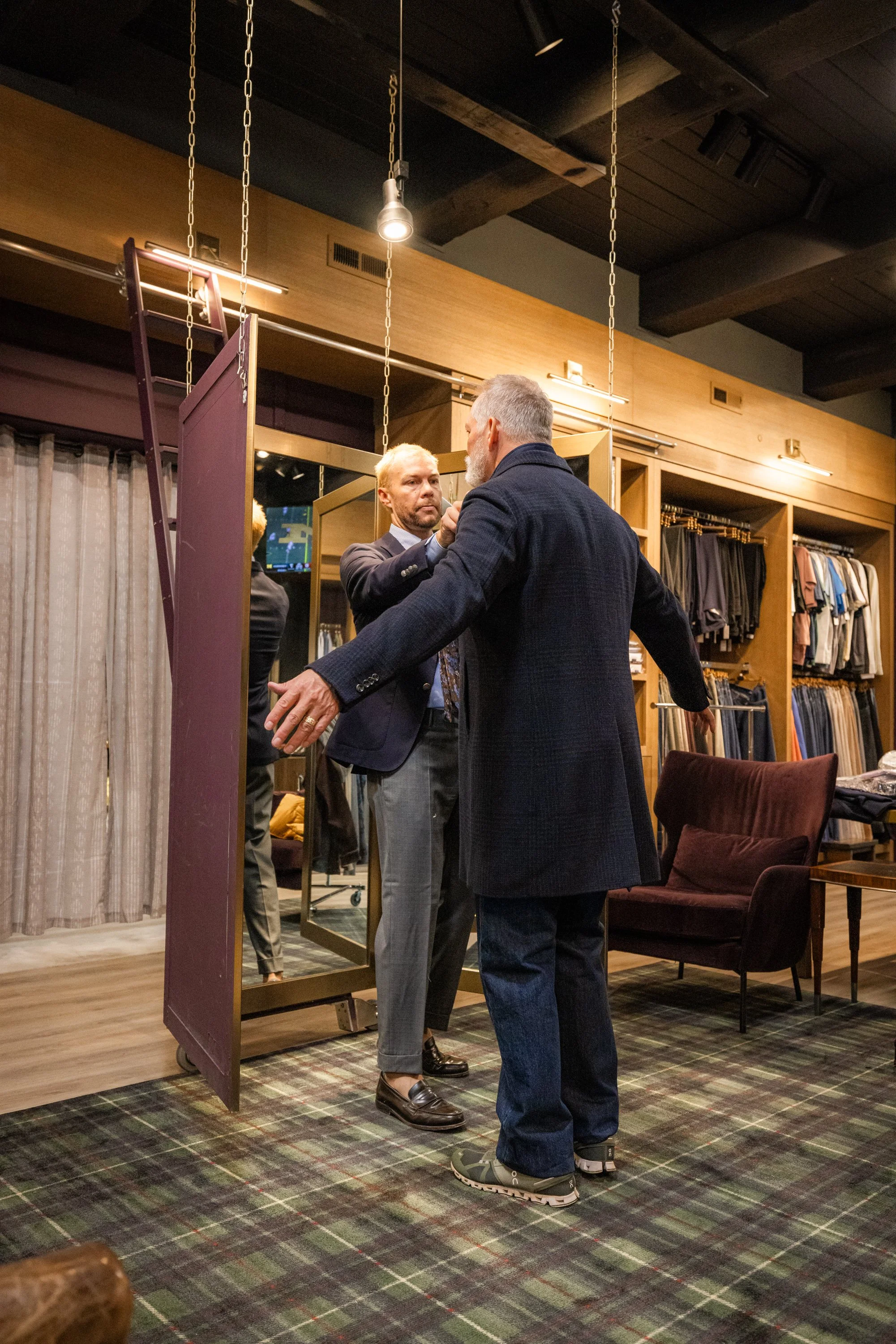
Static Fit vs. Real Fit
Most conversations about how a suit should fit stop too early. They cover the obvious markers—sleeve length, jacket closure, trouser break—and leave it there. Those things matter, they just don’t tell the whole story. Real fit shows up once you start moving.
A jacket that looks clean when you’re standing can pull across the back the moment you reach forward. Trousers that fall perfectly over your shoes can shift or twist after a few hours of walking and sitting. The collar that sat flat in the fitting room may start lifting once your posture naturally relaxes over a long day.
None of these problems are dramatic on their own. But they accumulate. By mid-afternoon, the suit stops feeling like something you’re wearing and starts feeling like something you’re managing—and that’s a problem worth understanding before it happens.
Where Movement Begins: The Shoulders
Everything in a suit starts at the shoulders. If they’re off, nothing downstream can fully compensate. In a static sense, shoulder fit is easy enough to read. The seam should sit at the edge of your shoulder, the line should be clean, and there shouldn’t be visible divots or overhang. That part is straightforward. Movement introduces a harder test.
As you walk, reach, or turn, the jacket should follow without resistance. Shoulders that are too narrow create tension across the upper back—a tightness you’ll feel constantly without quite being able to place it. Too wide, and the sleeve and chest lose their structure, shifting more than they should with every step.
Good custom suit fit doesn’t just sit correctly, it stays balanced while you move. That balance starts here, and every other part of the garment depends on getting it right.
The Armhole and Why It Matters More Than You Think
Armholes don’t get much attention, but they quietly determine how a jacket behaves all day.
Off-the-rack suits tend to use lower armholes because they’re more forgiving across a wider range of body types—which makes sense for mass production, but creates problems in motion. Raise your arm, and the entire jacket lifts with it. Reach across a table, and the chest shifts out of place. It’s not uncomfortable in an obvious way. It’s just constant, low-level friction you’re compensating for without realizing it.
Higher armholes—standard in quality tailored suits—change that dynamic entirely. They sit closer to the body, letting the arms move more independently from the jacket. The result isn’t a tighter feel so much as a more controlled one. Movement is cleaner, and the rest of the garment holds its position while you move. It’s one of those details that’s hard to describe until you’ve experienced both sides of it.
Sitting Down: The Moment Most Suits Fail
If there’s one moment where fit breaks down fastest, it’s when you sit down. Sitting exposes everything at once: jacket balance, trouser rise, fabric tension, construction choices. A suit that looked fine standing up will reveal all of its compromises the moment you settle into a chair—which is relevant considering that’s where most of the workday actually happens.
A jacket with proper fit should close comfortably when standing and relax naturally when you sit. It shouldn’t strain across the button or pull at the lapels. When it does, the balance is off somewhere—usually in the chest or waist—and no amount of adjusting will fix it for long.
Trousers have their own version of this. A rise that’s too low shifts downward when you sit, pulling at the waistband and creating tension through the seat. Too high without the right balance, and they feel restrictive instead. The goal isn’t any particular height, it’s stability. They should stay where they belong without needing to be pulled back into place every time you stand up.
Any guide to how custom suits should fit that only addresses standing posture is leaving out half the picture. Sitting isn’t an edge case. For most people, it’s most of the day.
Walking and Wear Over Time
Movement isn’t just about isolated actions. It’s about what happens when those actions repeat across eight or ten hours. Walking across a parking lot, moving through a building, shifting in your seat during a long meeting. Individually, none of it is demanding; collectively, it reveals whether a suit is genuinely working with your body or quietly working against it.
A well-fitted suit holds its shape without feeling rigid. The jacket stays aligned, the trousers move without twisting, and nothing requires frequent correction. You stop thinking about the garment because it stops demanding your attention.
When that doesn’t happen, you feel every small imbalance. A sleeve that drifts forward. A waistband that works its way loose. A jacket that never quite settles back into place. None of it is catastrophic on its own. But it’s persistent—and persistence is what makes it matter.
That’s the gap between a suit that’s good and one that’s actually great to wear.
Fabric and Its Role in Movement
Fit isn’t only about measurements. Fabric is doing real work in how a suit behaves once you’re actually moving in it. Heavier cloths tend to hold structure better, which helps maintain a clean line across a long day.
However, they can also feel restrictive if the underlying fit isn’t quite right—and stiffness compounds over time. Lighter fabrics move more freely and breathe better, but they can lose shape without enough body behind them to hold the line.
This is where made-to-measure suits and custom suits tend to pull ahead of standard options. The combination of better cloth selection and more precise fit creates a kind of balance that’s hard to achieve off the rack, enough structure to hold form through movement, enough flexibility to stay comfortable as the day stretches on.
You won’t notice it the moment you put the suit on. You’ll notice it at the end of the day, when it still looks the way it did when you started.
Northern Utah and the Reality of Daily Movement
In Northern Utah, movement isn’t just about what you’re doing, it’s also about where you’re doing it, and how quickly that changes.
A typical day here might start with cold morning air, move into a climate-controlled office for several hours, and then shift again before the day is over. That kind of constant environmental transition puts real pressure on how a suit fits and feels, pressure that a garment built for a single context will eventually struggle with.
A jacket that’s too heavily structured becomes uncomfortable indoors. One that’s too loose loses its line the moment you step outside. Trousers that fit fine in a warm room can bind up in the cold or vice versa. These aren’t dramatic failures—they’re the kind of small, persistent discomforts that accumulate into a long day.
Men’s suits that handle these transitions without requiring constant adjustment tend to share one quality: they were built for how the wearer actually lives, not for how clothing is typically sold.
Why Fit Changes Over the Day
There’s one more factor that rarely gets mentioned in fit conversations: your body doesn’t stay the same from morning to evening.
Posture shifts. Muscles relax. The way you carry yourself at 8 a.m. isn’t quite the same as how you’re sitting at 3 p.m. after a full day. A suit that only fits one version of you—the upright, fresh version—is going to reveal that limitation eventually.
This is where the custom suit process earns its value. A good fit isn’t just about precision, it’s about building in enough tolerance to account for those natural changes without losing balance. Not so tight that any shift creates a problem. Not so loose that the garment starts to drift. Just enough room to move without losing shape.
That kind of fit doesn’t feel exact in a rigid sense. It feels forgiving in the right ways, and that’s a harder thing to achieve than it sounds.
When a Suit Disappears
The best-fitting suit doesn’t draw attention to itself. Not in a style sense—people can still notice how it looks—but in how it feels to wear. You’re not adjusting it, compensating for it, or working around it. It simply does what it’s supposed to do and stays out of the way.
That’s what good fit actually looks like in practice. Movement doesn’t expose flaws. Time doesn’t introduce new ones. The garment holds up from the first hour to the last without requiring anything from you in return. It’s easy to underestimate how much that matters until you’ve spent a full day in a suit that couldn’t deliver it.
Suits in Motion
Understanding how a suit should fit means looking past the mirror. Static measurements matter, but they only answer part of the question. Real fit reveals itself in motion: in how the jacket moves, how the trousers settle, and how the whole garment holds together across a full day rather than just a fitting room moment.
A suit that works in motion removes friction from the day. It doesn’t fight your body, doesn’t need constant correction, and doesn’t change character by mid-afternoon. That’s what separates something that looks right from something that actually is. And once you’ve worn a suit that holds up that way, it’s hard to settle for anything less.